Jupiter sounds like a thousand-foot answer. Biggest planet, great big storm, practically has its own entourage. Then CrowdOrRare scoring hands it 625 feet. Switch to Rare, give the very same answer, and Jupiter is worth 50. What happened to the other 575 feet? Look at the neighbors. Earth sits above Jupiter at 32%. Neptune sits way down at 1%. Those two planets set the price of every ticket on this board.
Use the board for this exact question
Here's how to read the flaps. The percentage beside a word tells you its share of this particular board. The editors give the entries Editorial Typicality Weights based on what feels like a typical answer to the prompt in American English. Together the entries account for 100%. You and three cousins could all pick Jupiter tonight. Tomorrow its weight would still be 20%. Nobody has to poll the cousins.
In Crowd Mode, find the biggest percentage. Divide your answer's weight by that number, multiply by 1,000 and round to the nearest whole foot. Jupiter brings 20 to a board led by Earth's 32. That's five eighths of the leader's weight and five eighths of the available altitude. You get 625 ft. Earth divided by itself gives you the full 1,000. That little blue marble sets the ceiling.
In Rare Mode, find the smallest percentage. Divide that by your answer's weight, multiply by 1,000 and round. On this board you start with Neptune's 1. Pick Jupiter and you get 1,000 × 1 / 20, or 50 ft. Pick Neptune and the two ones cancel. The game gives you 1,000 ft and leaves you to explain how you knew exactly when to think of Neptune.
Work through all eight planets
Cover the last two columns with your hand. If Earth pays 1,000 in Crowd, how far should Mars take you? Try making a rough call before doing the division. Its 13% is a little less than half of 32%, so anything north of 500 feet ought to set off a small alarm. Now move your hand.
Mercury is where a pencil earns its keep. Six divided by 32 is 0.1875. Multiply first and you've got 187.5 feet. The half goes up, so the card says 188. Round the fraction to 0.19 on the way through and you'll be looking for two feet the balloon never flew. Saturn gives you a chance to check the other direction. One thousand divided by 15 comes to 66 and a bit more than a half. Your Rare award is 67 ft.
Now look at Uranus and Neptune. Three percentage points separate them. In Rare those three points span 750 feet. Once you've found a 4% answer, it's easy to imagine there's little left to gain. The bottom two lines make a fine case for taking another breath and trying to remember the name of that last planet. Just take the breath before you submit.
Follow a word from the keyboard to the chart
Maybe you've got a friend who'll only call Earth Terra. Let them have this one. Each board has a list of accepted names and another of spellings or aliases attached to those names. The game looks for a match for what you typed among the board's full names first, then checks the aliases. On the planet board, Terra sends you straight to Earth. The flap says Earth, the log says Earth, and your friend collects every foot Earth would earn.
The game folds case, strips common accent marks and ignores spacing and most punctuation when it compares words. It doesn't guess which word you nearly typed. There's a good little trap on the length-units board, too. Type mm for millimeter and you're fine. Type Mm and you've asked for a megameter, a rather different shopping list for the hardware store. That board checks the case of the short SI symbols. Spelling out “millimeter” works if you don't trust your shift key.
When you draw a blank, View eligible entries will show you the names in alphabetical order. You'll still have to guess which one carries the most weight. Reveal answers · 0 ft is a different button with a very candid price tag. It settles the leg and shows the percentages. If you're choosing between two names and still want to score, use the alphabetical list.
Check the fifteen reference cases
The workbench above lets you run the little arguments people actually have over this game. Start with case 3. Jupiter comes up in both formulas, so you can see exactly where the 20 goes. Then try its neighbors. Cases 1 and 2 give Earth and Neptune their thousand-foot turns. Case 4 leaves Earth in Rare, where being the planet everybody remembers buys you all of 31 feet.
Cases 5 through 7 are worth playing back to back. Someone has leaned on the shift key, someone brought Latin to trivia night, and someone left the last letter off Neptune. All three entries land. Then comes case 8, Pluto. The scope says eight planets orbiting the Sun. Pluto gets zero for this attempt, however fondly you remember its place in your classroom. The clock keeps running if you've got one. You can still type Mars.
The last one is a nice bet to settle across the table. Use #seed=star-chart&mode=rare&timer=20&v=1. Both orders start with p060, then p008, p079, p007 and p077. Your friend can finish before you even sit down and you'll still get that sequence. The clock starts with each question on your screen. An especially fast friend can't use up your thinking time.
See what the eight categories contribute
The 128 prompts come in eight sets of sixteen. Geography, Food, Animals and Everyday Objects share the shelf with Science, Film & Culture, Sports and Language. A flight deals five distinct prompts. You can see two questions about sports without spotting a single cheese. There's no missing cheese round to add back when you check your total.
Try searching the answer index for moon. It couldn't buy a foot on the planet board. Move over to Language and the question asks for a word containing consecutive O's. Look who's earned a place on the board. Moon carries 20% against book's 38%, good for 526 Crowd feet. Same spelling as the rejected planet guess. The question supplies both the guest list and the going rate.
Reconcile a total from the result card
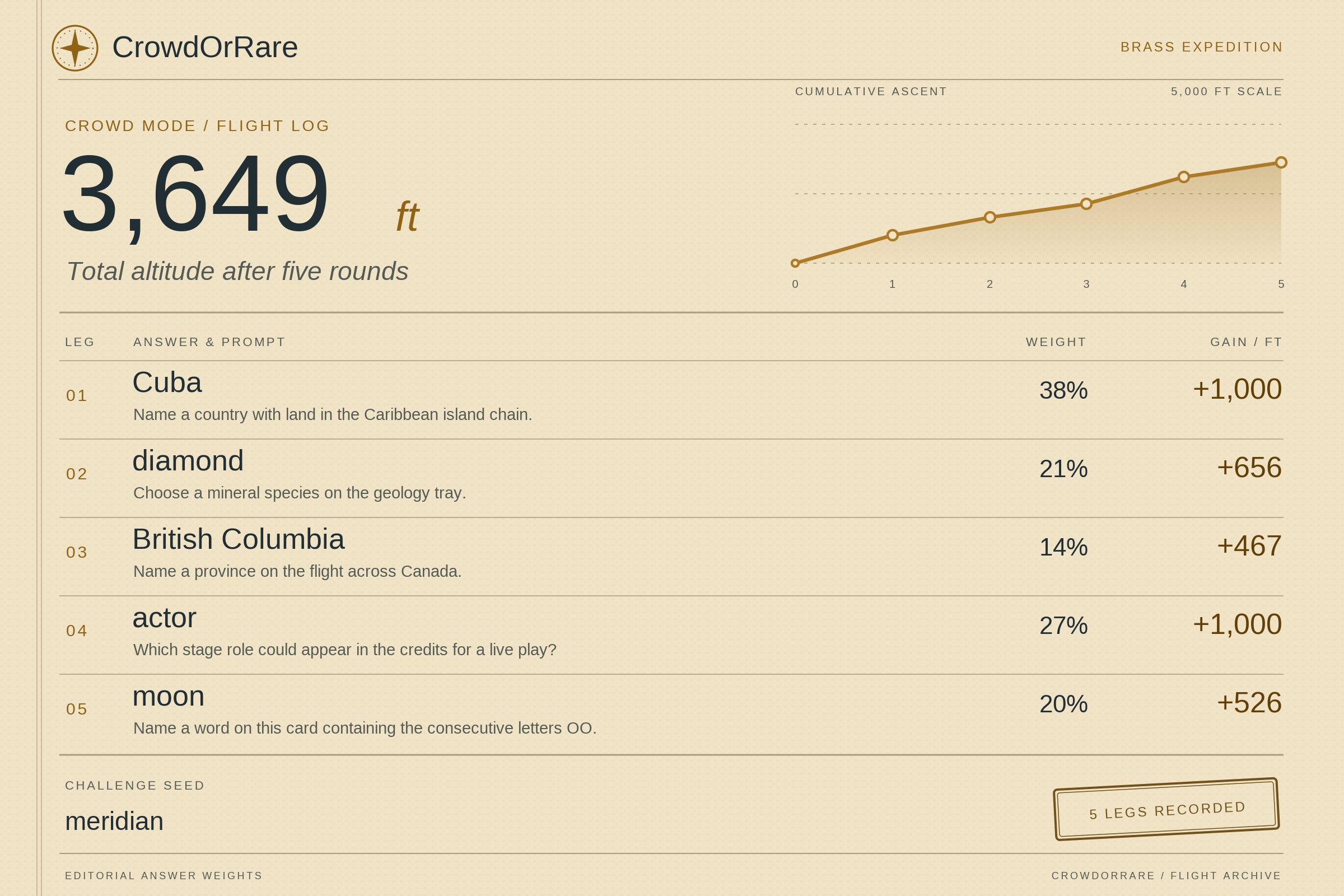
Pull up Meridian in the flight calculator and read its Crowd log from the top. Cuba opens with 1,000 ft. Diamond is worth 656, British Columbia adds 467, and actor picks up another 1,000. That last word with a pair of O's? It's moon for 526. Add the five whole-foot payouts and you land at 3,649 ft. You can do the sum on the back of a napkin and get the exact number on the card.
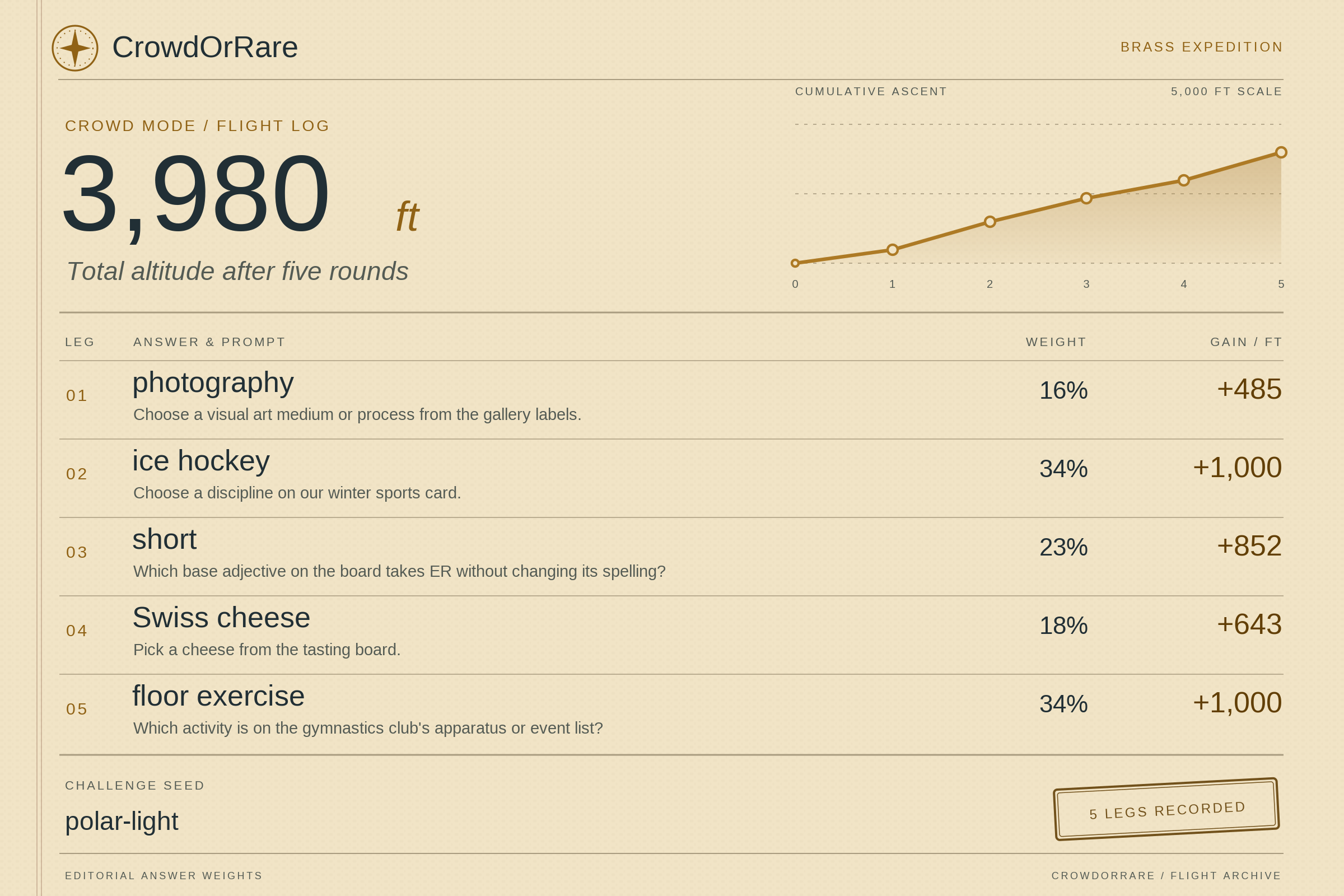
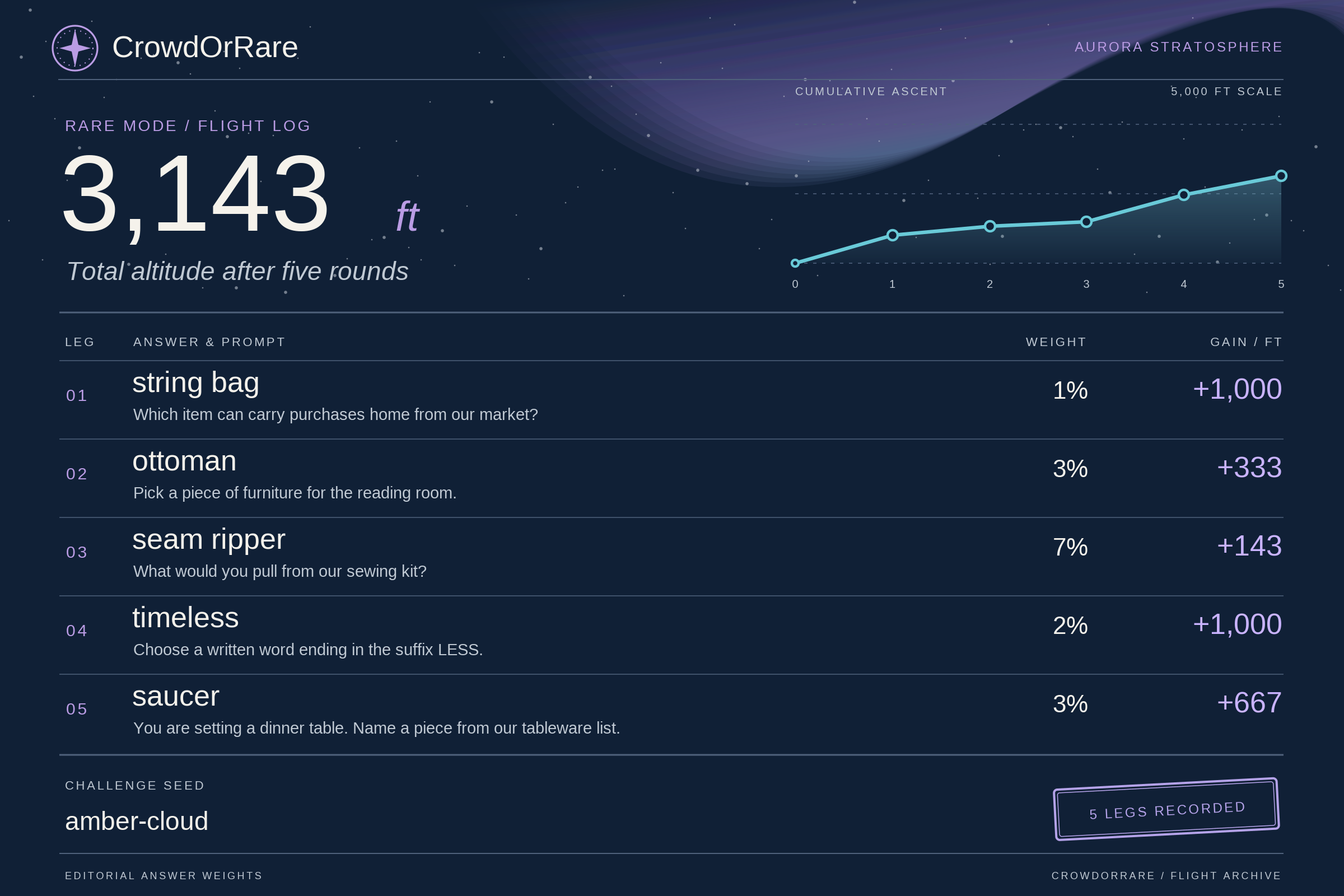
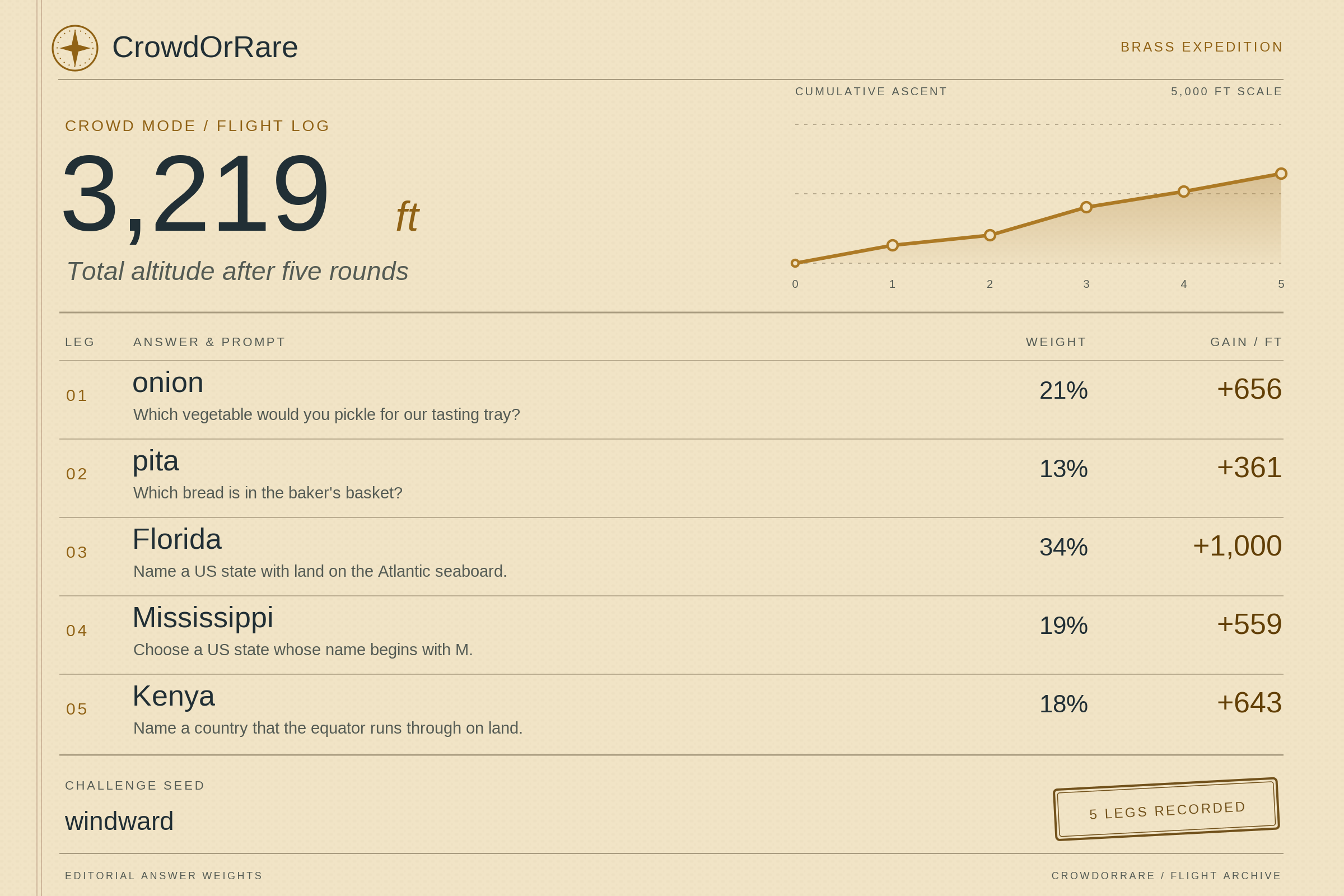
There are five more receipts in the rack. Larkspur comes in at 2,733 ft, Polar Light at 3,980 ft, Amber Cloud at 3,143 ft, Windward at 3,219 ft and Night Watch at 2,650 ft. If two cards disagree, start at the first leg where the feet split. Two different words send you to the answer board. Two identical words on that board send you to the mode printed at the top. It's a mercifully short investigation.