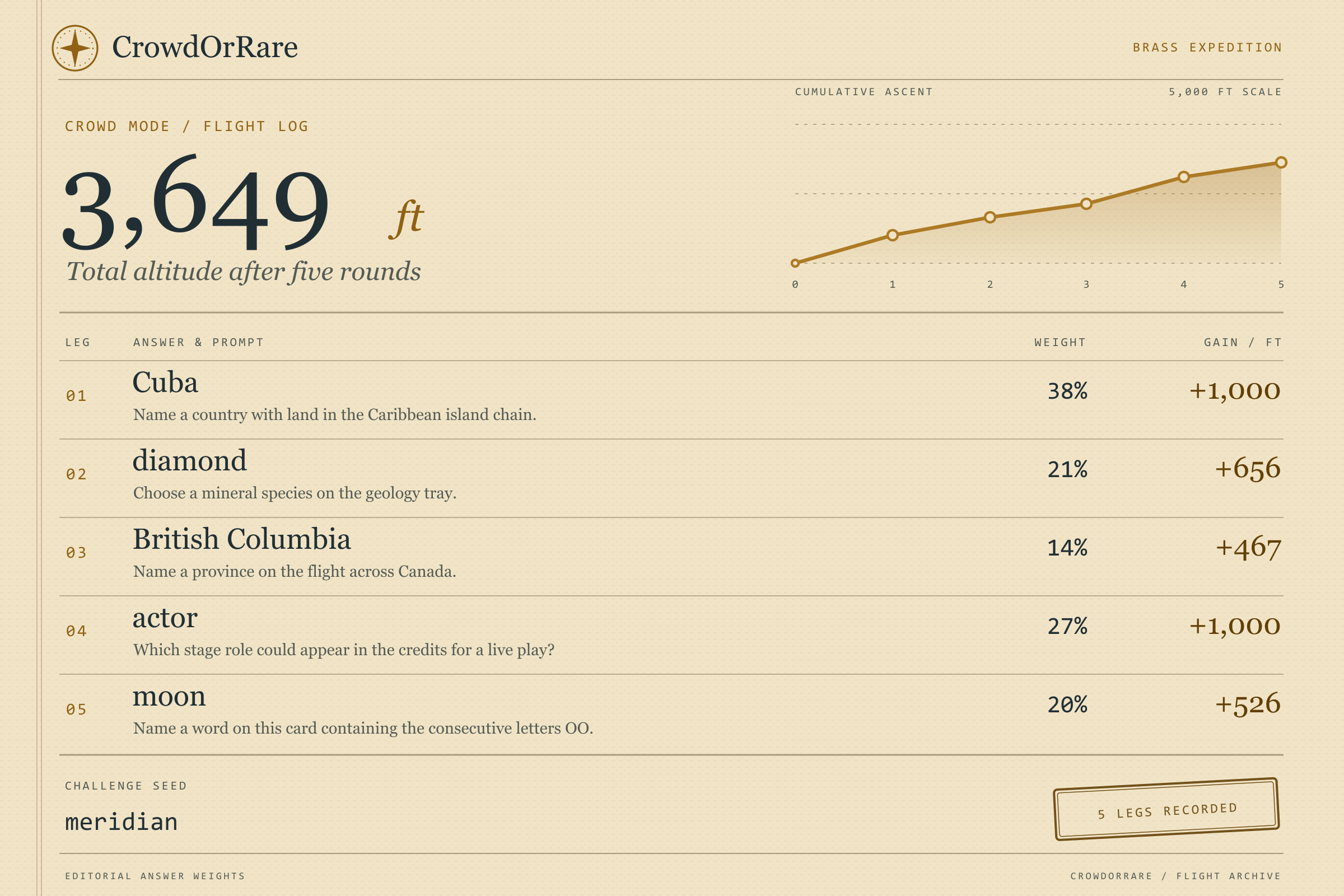
Meridian
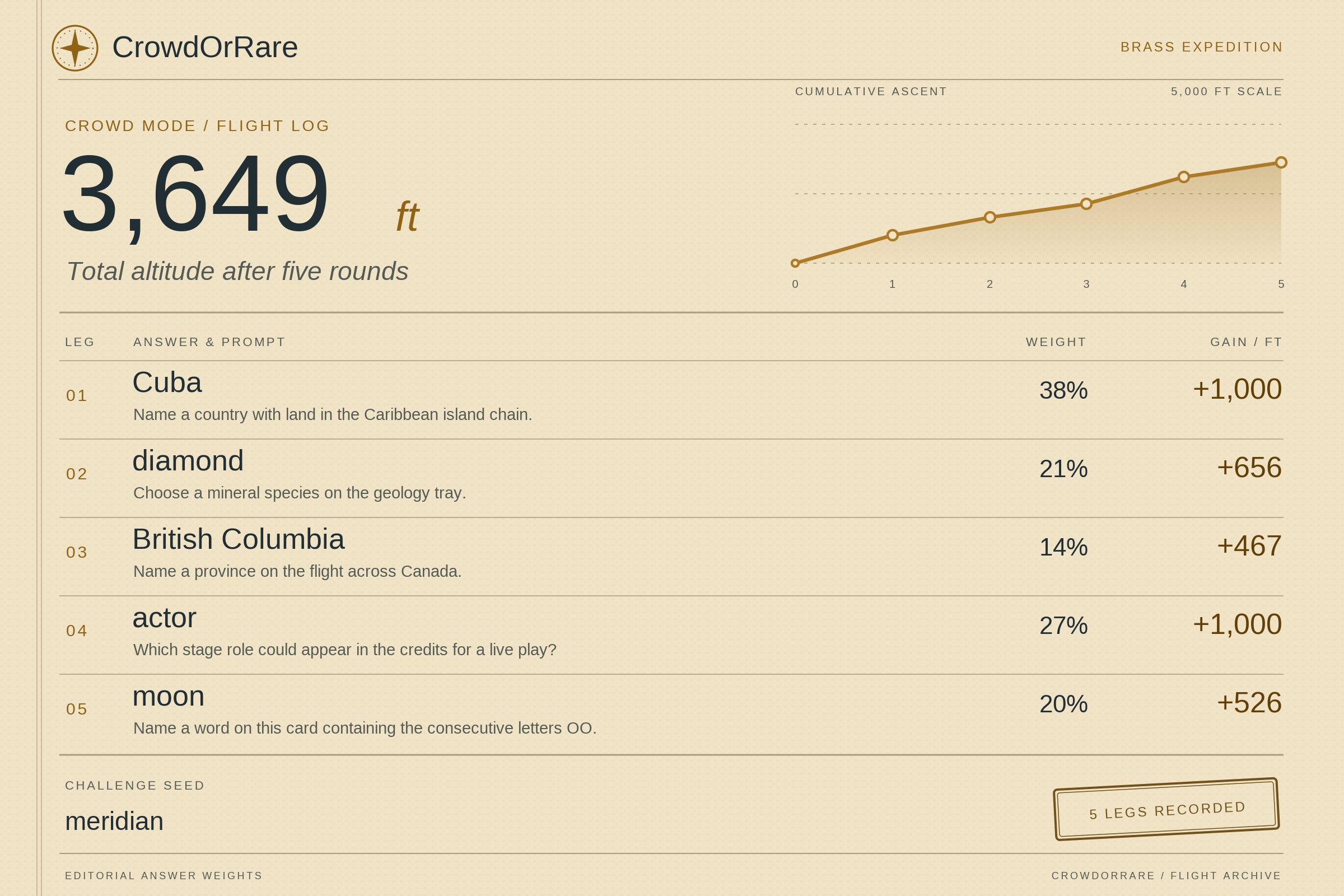
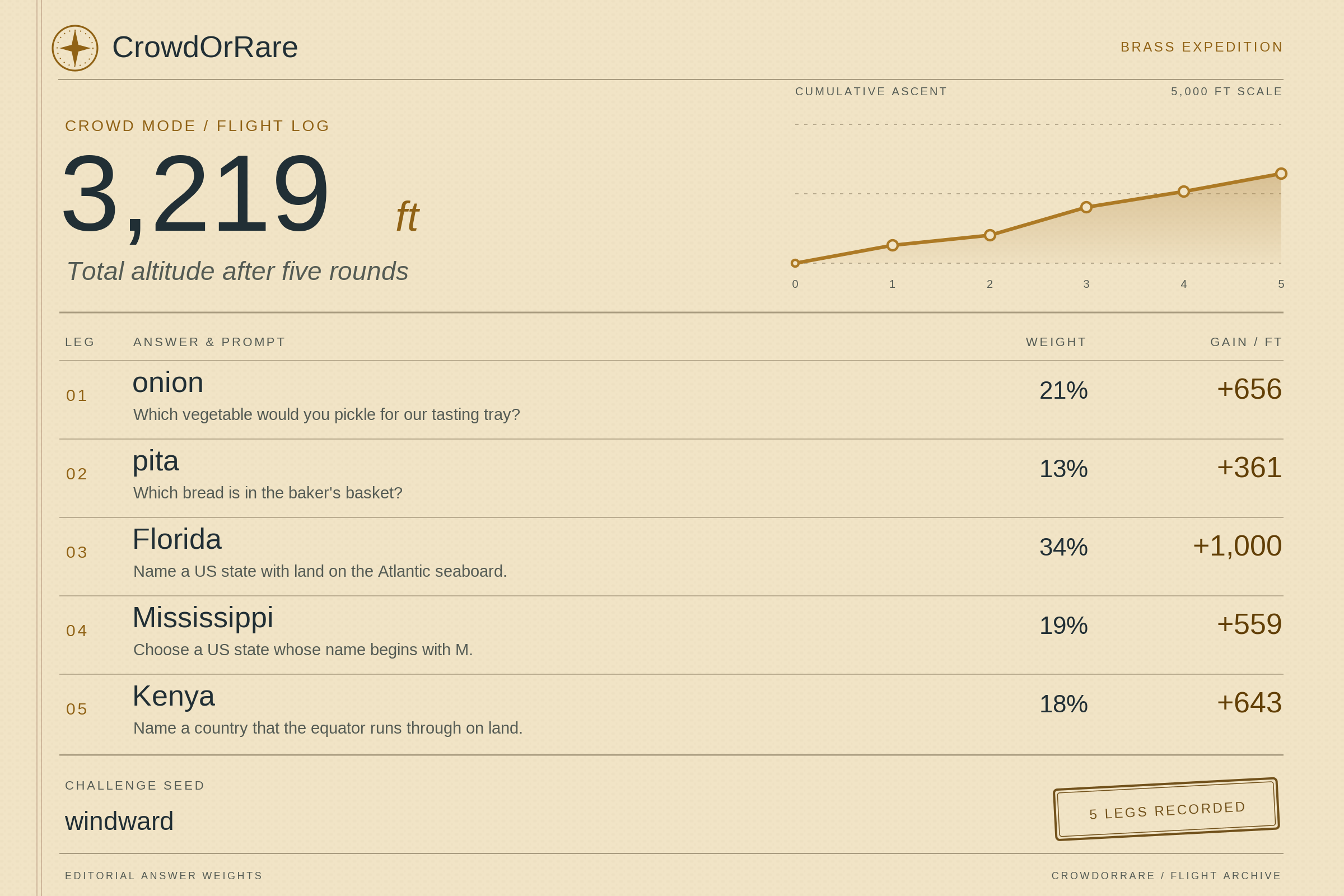
3,649 ftOn the first leg, Cuba carried 38% of the board and earned 1,000 feet.
Five answers and awards
- Cuba (38%)+1,000 ft
- diamond (21%)+656 ft
- British Columbia (14%)+467 ft
- actor (27%)+1,000 ft
- moon (20%)+526 ft
Find the least common answer on each board. Five questions, up to 5,000 feet.
All 8 entries in this set score.
No completed flights saved in this browser.
Explore six recorded flights. Open a log to inspect the awards, or take the same five questions yourself.
On the first leg, Cuba carried 38% of the board and earned 1,000 feet.
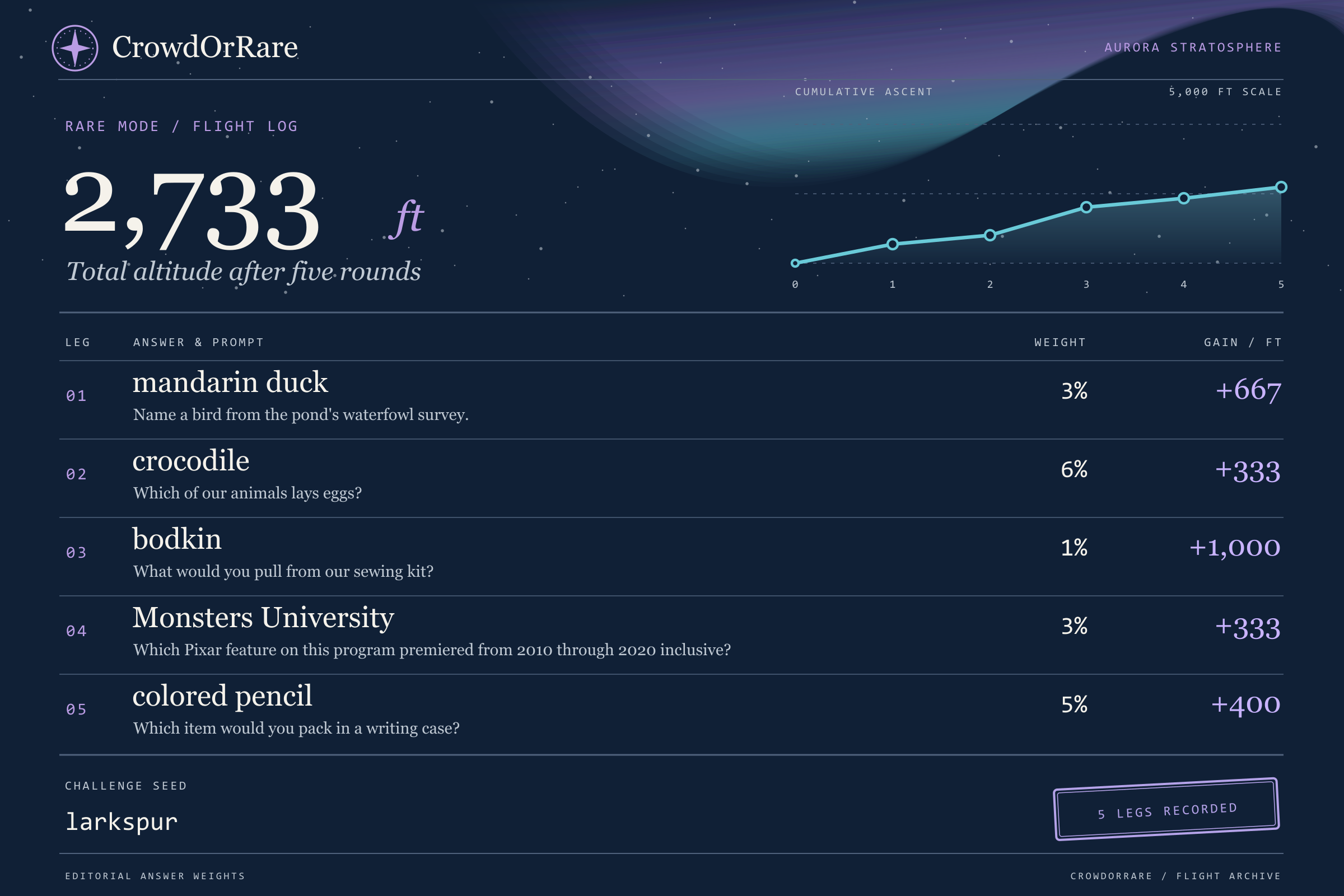
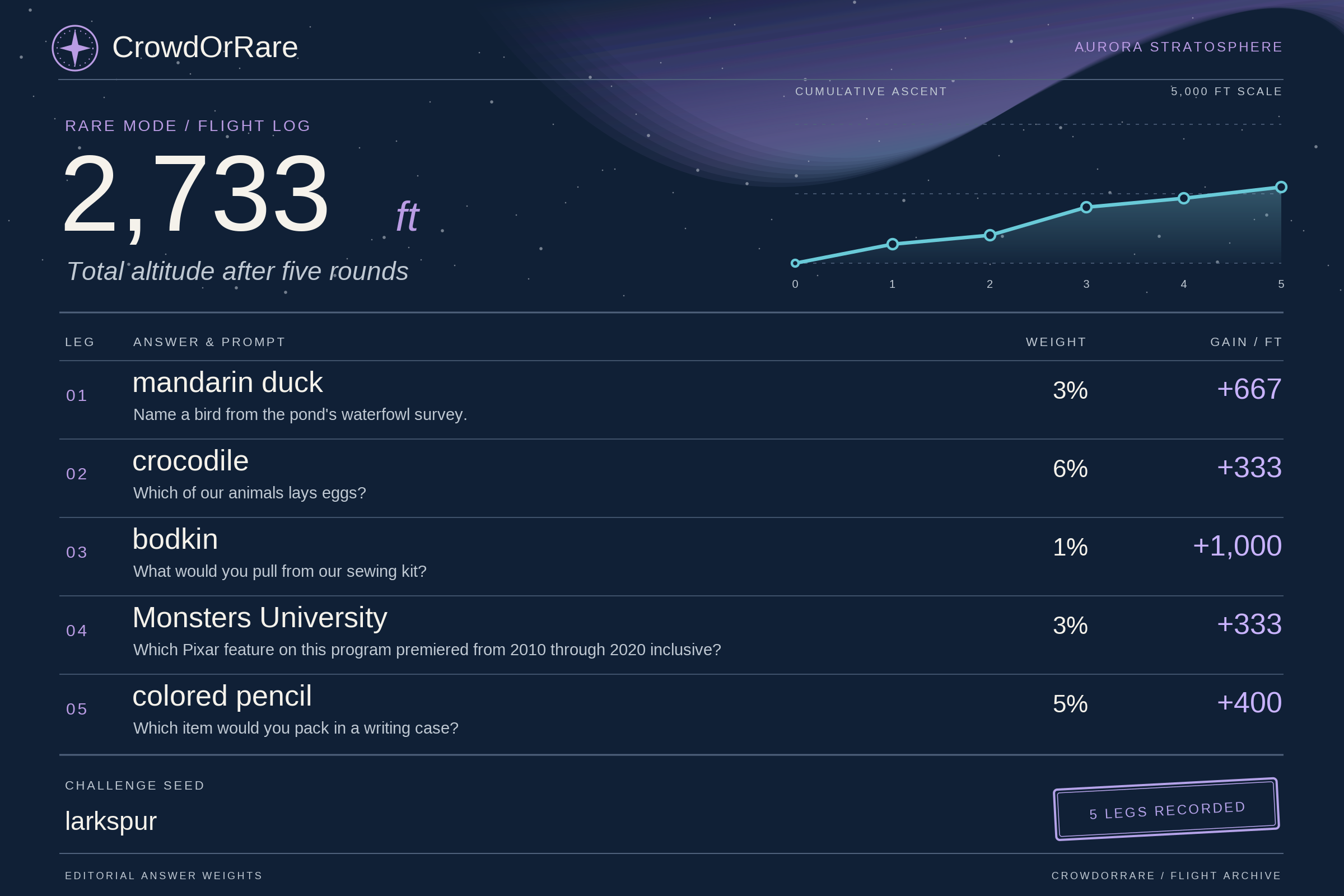
On the first leg, mandarin duck carried 3% of the board and earned 667 feet.
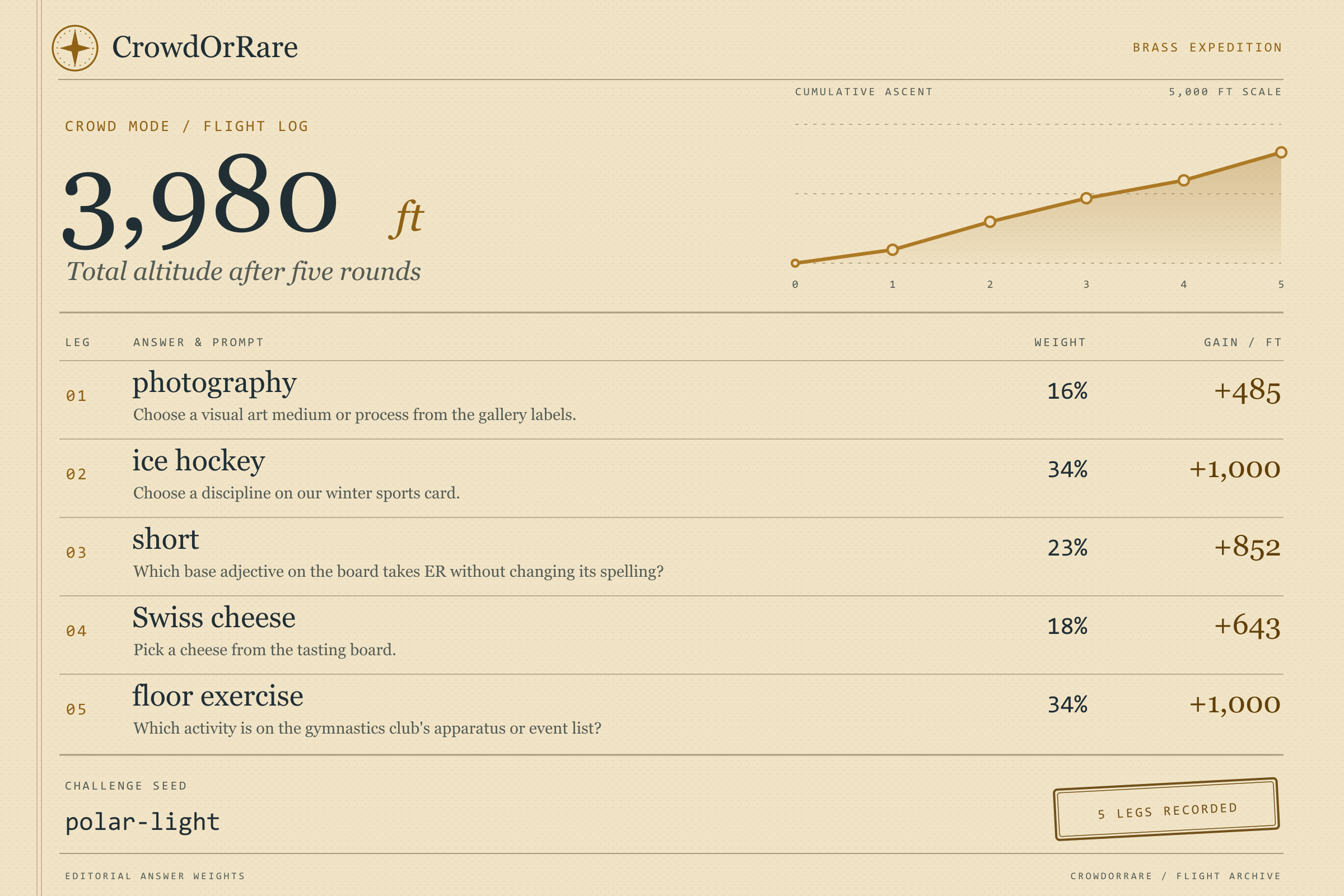
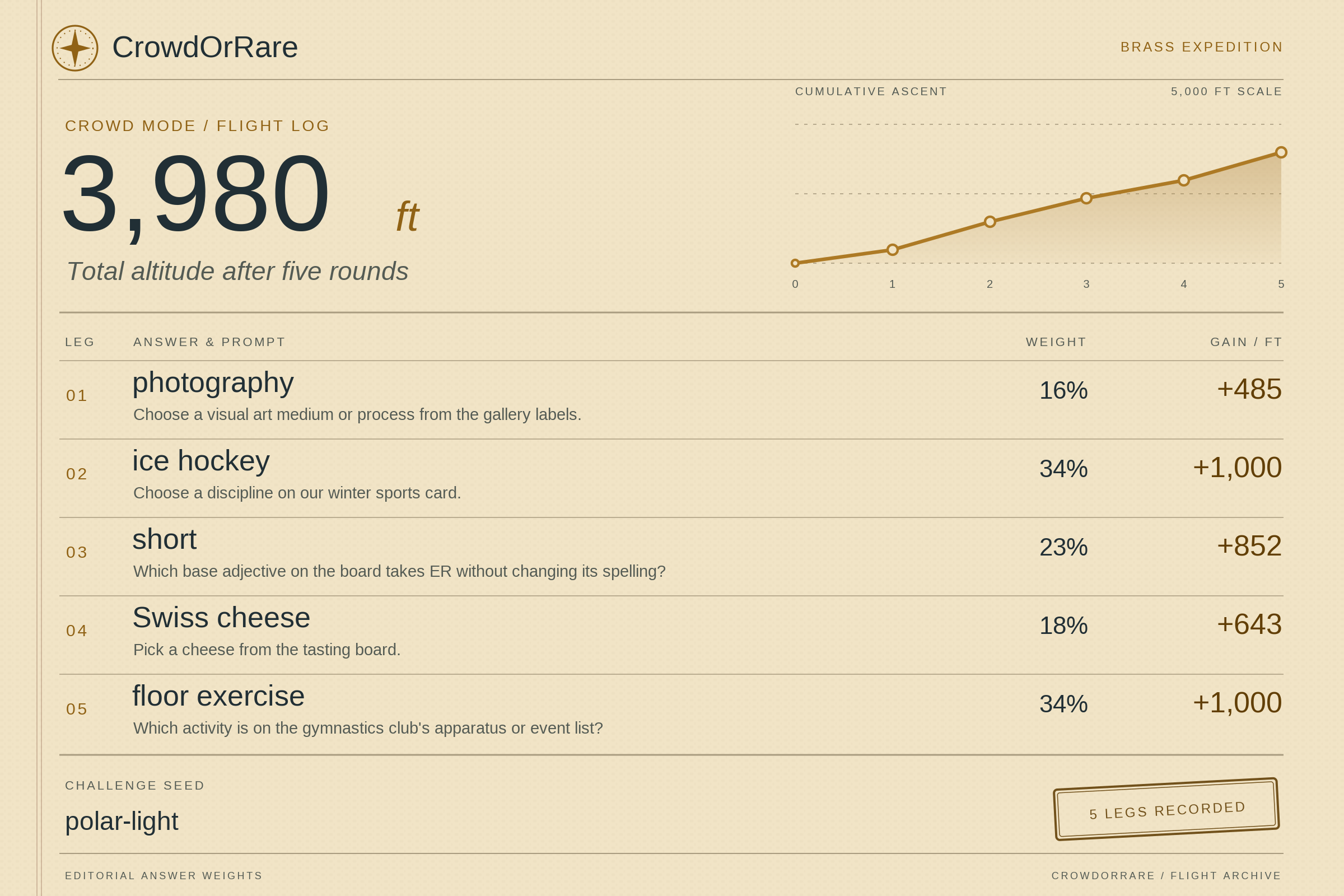
On the first leg, photography carried 16% of the board and earned 485 feet.
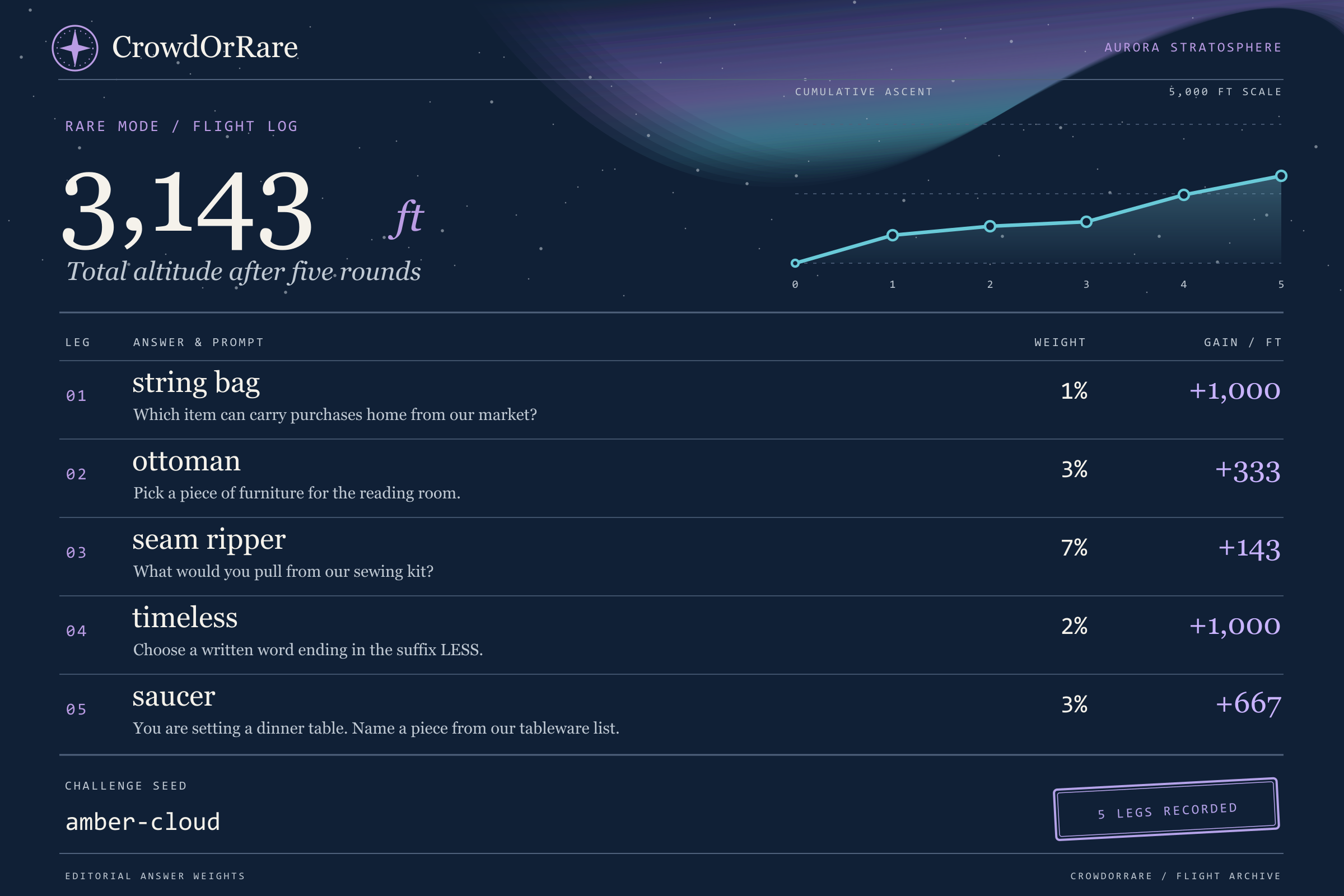
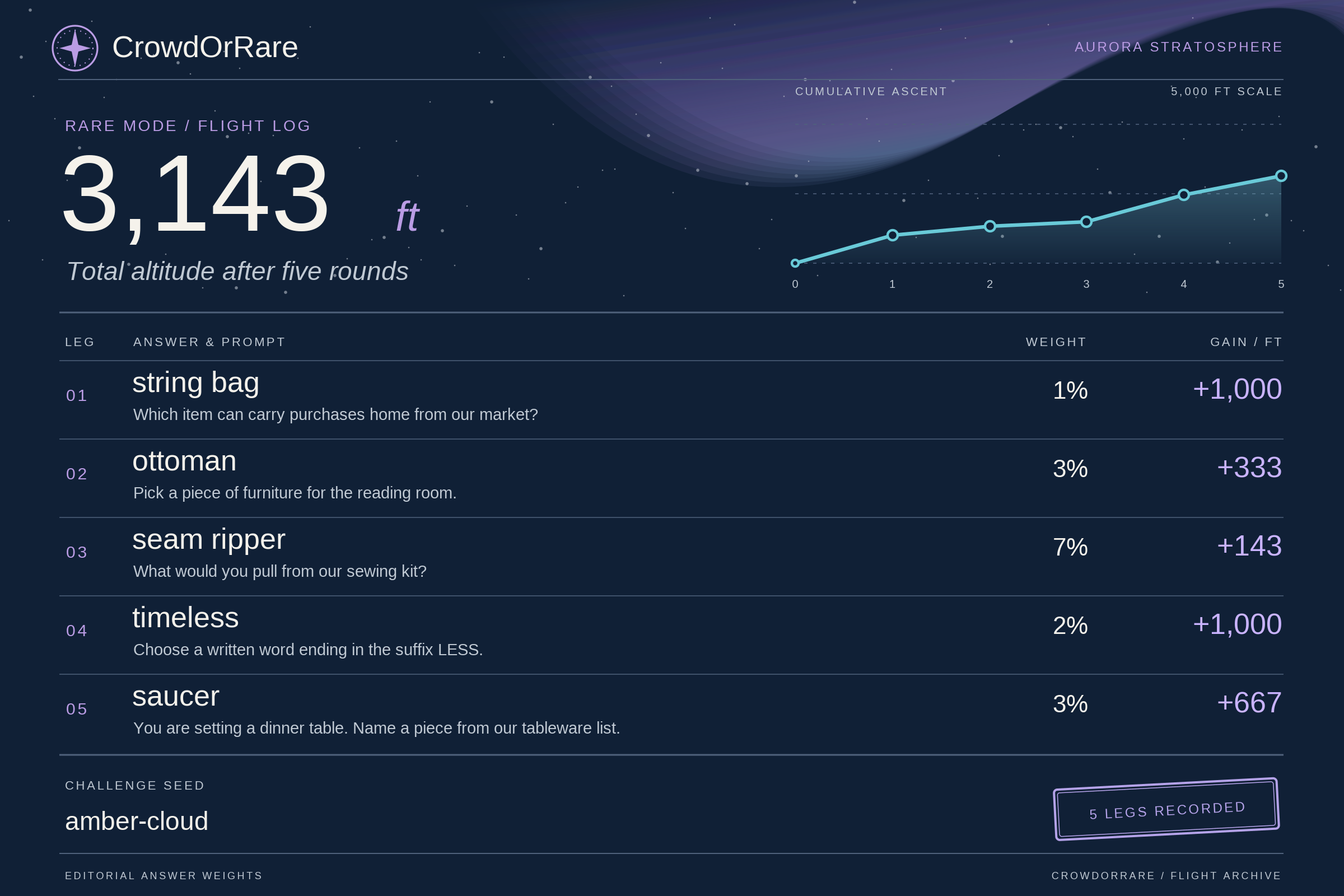
On the first leg, string bag carried 1% of the board and earned 1,000 feet.
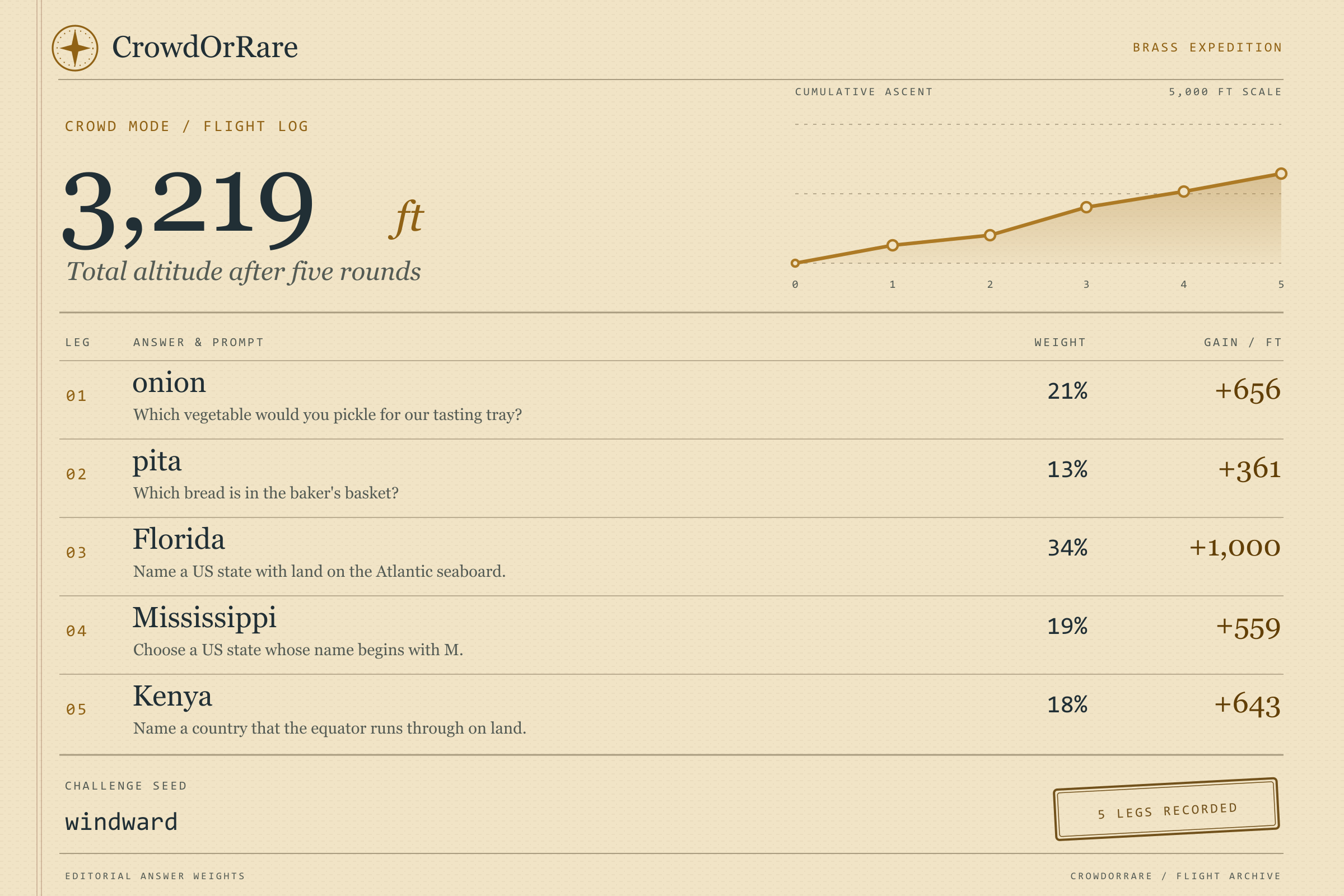
On the first leg, onion carried 21% of the board and earned 656 feet.
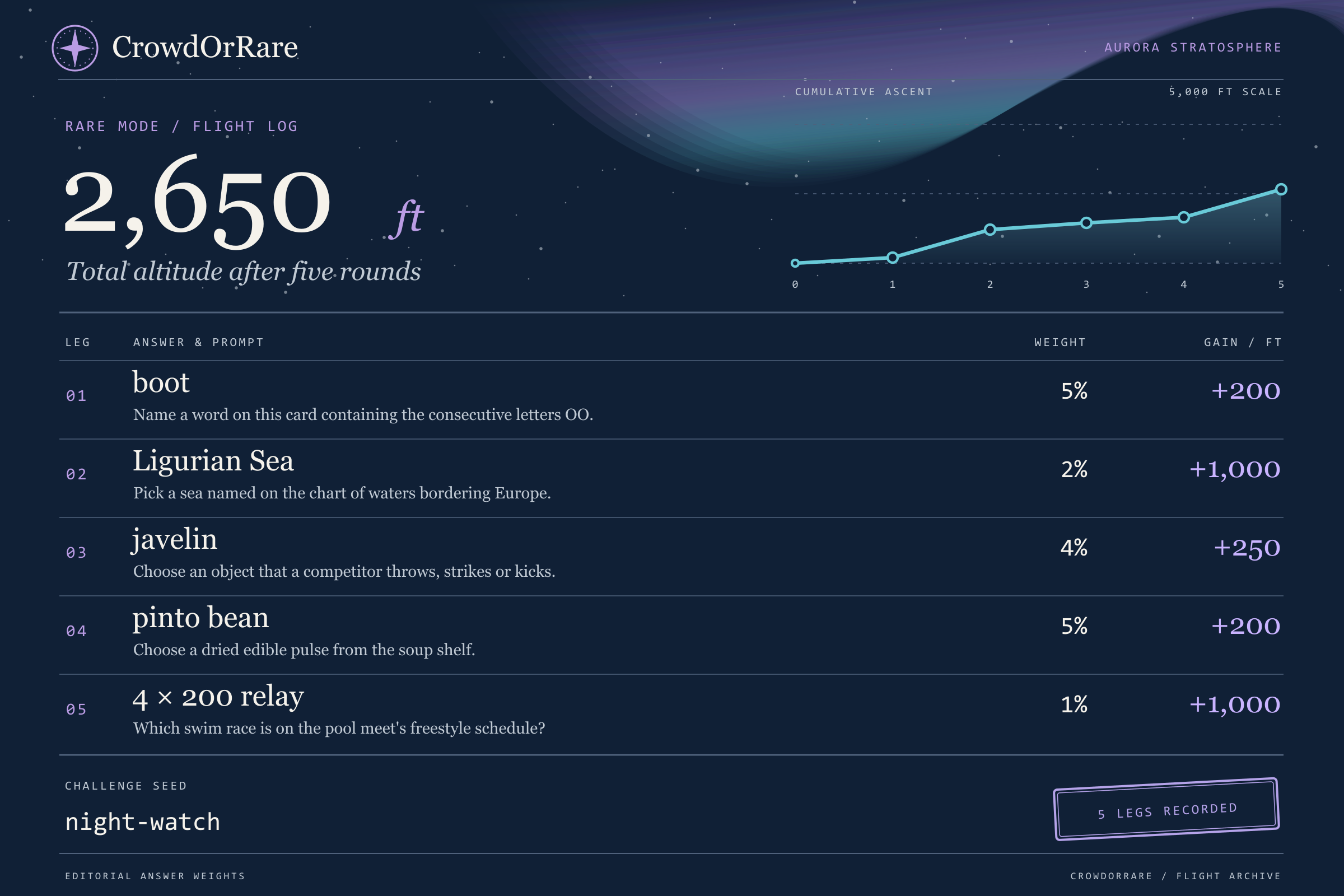
On the first leg, boot carried 5% of the board and earned 200 feet.
Here's a bet you can settle in five questions. Pick a postcard, cover the total with your thumb, and look at the first leg. How well do you think the rest went? Polar Light opens with a modest 485 ft for photography and finishes at 3,980. There's a lot of sky left after one so-so guess.
Give the next player the link while the answers are still a secret. Once they've landed, trade cards. Brass Expedition looks like something you'd find tucked inside an old atlas. Aurora Stratosphere puts your five calls against a night sky. Save the 2400 × 1600 PNG for the group chat, or open the SVG and zoom in on the single word that cost somebody bragging rights.
 GeographyTrace the coastline with a finger before you commit to a state.
 FoodPicture the pickle spear that comes with your sandwich.
 AnimalsAt the duck pond, who gets recognized even without binoculars?
 Everyday ObjectsOpen the sewing tin. Give the thimble a sporting chance.
 ScienceAll eight planets qualify. Which one did you learn to spell first?
 Film & CultureStay for the credits. The lighting designer could win you this one.
 SportsPicture the object in the player's hand just before the throw.
 LanguageTwo O's in a row? A goose can get you surprisingly far.
Pick a subject to open its shelf of sixteen questions. If you'd like to keep tomorrow's surprises intact, look up just the board you played. A single word can make a fine souvenir. You may never look at a goose in quite the same way again.
Quick, name a planet. Set aside the one you almost blurted out. You'll want it for Crowd Mode. If you're playing a reverse trivia game online, though, you have time for a much better question. Which planet did your third-grade self have to squeeze onto the very edge of the poster? All that construction paper for the Sun, and poor Neptune got half a blue dot. Type Neptune. That little dot just bought you 1,000 ft.
On the CrowdOrRare planet board, the temptation to take Earth is perfectly sound. It has a 32% weight, the heaviest of the eight. In Crowd that's a full 1,000 ft for remembering where you live. Rare pays 31 ft for the same address. You can almost feel your thumb changing its mind over the Submit button.
Try taking the long way home. Mars has the rovers, Saturn has the rings, Jupiter has that storm. By now you're building a little solar system in your head, and the two planets you haven't given any props to are pretty good bets. Uranus gets 250 ft at 4%. Neptune, at 1%, gets the whole thousand. You'll still get credit if Jupiter is as far as you go. Its 20% earns 50 ft in Rare or 625 ft in Crowd.
There's another blue dot somebody will lobby for. Give Pluto a sympathetic hearing, then read the question aloud. It asks for one of the eight planets orbiting the Sun. The board has a slot for every one of those eight, and Pluto's dwarf-planet credentials won't open a ninth. This is where Rare gets fun. You can be awfully sure a name belongs to the subject and still need to find your way back to the question.
Start with the biggest word in the room. On the Night Watch flight, leg two asks for a sea bordering Europe. Mediterranean. Good. What other names have you seen written in blue on that part of the map? Maybe Adriatic, maybe Aegean. Now picture the curve of the Italian coast by Genoa. If Ligurian Sea comes back to you, go ahead and enjoy the tiny private ceremony of typing it.
The reveal pays off that tour of the coastline. Mediterranean Sea weighs 27% and earns 74 ft in Rare. Adriatic Sea gets 222 ft at 9%, and Aegean Sea gets 333 ft at 6%. The Ligurian Sea has the board's smallest weight, 2%, good for 1,000 ft. It's satisfying to see how far each of your half-formed guesses would have gone. Mine usually acquire a lot more conviction after the numbers appear.
You can do this with a perfectly ordinary word, too. Take the card asking for three-letter words ending in AT. Cat leads to bat, which somehow leads right back to cat. Give the poor alphabet a rest and change scenes. Walk into a factory. What holds all that liquid? A vat. Three letters, on the board, 2%. A word a first grader could sound out just took the round.
Then try Larkspur. Its first prompt takes you to a pond. A mandarin duck earns 667 ft at 3%, an excellent return for remembering such a splendidly dressed bird. A pintail earns 1,000 ft at 2%. If your mental picture of a duck begins and ends with a green head, pick the mallard. The reveal gives you seven more birds to picture the next time around.
Those percentages come from Editorial Typicality Weights. The CrowdOrRare editors assign them to model which answers tend to come to mind in American English for each prompt. Imagine sitting down with a birdwatcher who's been hoping somebody would finally ask about pintails. Their instant answer can be your wild guess. The published weight stays the same for both of you, however many birdwatchers turn up.
Here's the arithmetic to do during a reveal. Take the smallest weight on the board, divide it by the weight you picked, multiply by 1,000 and round to the nearest whole foot. On the duck board, two divided by three gives you the mandarin duck's two-thirds share of the prize. On the planet board, one divided by four explains exactly what happened to Uranus. You can read the whole chart that way without memorizing a price list.
A fine place to test your eye is the sewing kit. Which feels rarer to you, a pincushion or a seam ripper? People who hem their own jeans are welcome to have strong feelings here. Pincushion weighs 3% on this board, seam ripper 7%. A bodkin sits below both at 1%. With that floor, the cushion earns 333 ft and the ripper 143 ft. Whoever learned the word bodkin from an actual sewing kit is having a very good afternoon.
Let's give you twenty seconds and a silent K. You have knee in the bank. You'd like something better. You're rattling through knife, knight, another knight spelled exactly like the first knight. Take a look at your hand. Knuckle works. At 2%, it's worth the full climb on that board. There's no speed bonus, so the few seconds it took to look down were well spent.
Of course, you might get all the way to your hand and come up with finger. At that point there's a lot to be said for good old knee. An unlisted guess leaves the question open, and the clock keeps moving. Submit a word you know fits while there's time. At twenty seconds the leg closes for zero. You won't get to cash in the backup you were so sensibly keeping in your head.
For an easier first pass, choose Relaxed and open View eligible entries. The names appear in alphabetical order with their weights still hidden. It changes the pleasure of the question. Now you're the casting director looking at eight perfectly qualified applicants. Who's going to be the name everybody overlooks? Pick one. Once the flaps turn, find the name that fooled you and work out the cue that might have brought it to mind.
One more trap for the generous soul who wants to give half credit to a second idea. The game takes one accepted entry per leg. Committing to pincushion is the price of finding out what bodkin was worth. If you just want to peek, Reveal answers · 0 ft closes that leg. The free look at the names is up above, under View eligible entries.
Send a friend a Rare flight with the timer set to 20 seconds. Ask them to save the score for later and tell you the word they almost typed. This works especially well on Night Watch. The first card asks for a word containing OO. One player looks at the book on the table. Another looks at the boot on the floor. Somewhere there's a third player still thinking about that pond. Goose, anyone?
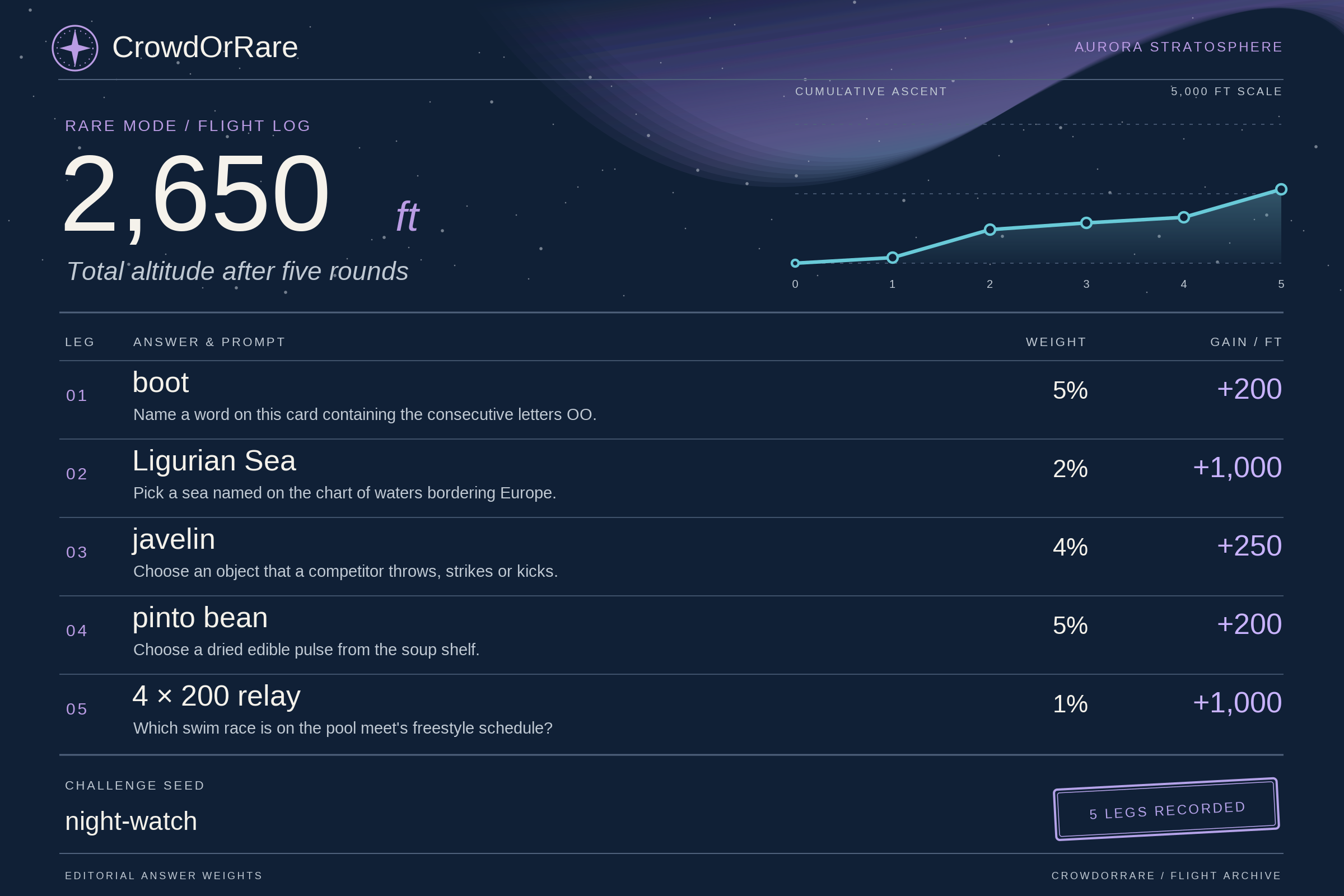
Book brings in 26 ft. Boot gets 200. Goose gets 1,000. Now you have a nine-hundred-and-something-foot argument for keeping waterfowl on the premises. On the recorded Night Watch card, boot and Ligurian Sea account for 1,200 ft between them. A javelin, a pinto bean and a relay race supply the rest of its 2,650 ft. See if you can beat that total on the same five questions.
For the rematch, use the same seed and select Crowd. You spent most of the OO question working your way past book. How quickly can you let yourself type it now? Take a look at the scoring guide, then give Crowd Mode a turn with the seed set to night-watch. See who can remember all five things they tried so hard to forget.
Try a little side bet. Austria on the European countries board and Oslo on the capitals board each carry 3%. Which one buys you more altitude in Rare? It feels like a trick until you put the two lists side by side. Slovenia sets the floor for the countries at 2%. Tallinn sets the floor for the capitals at 1%. You get 667 ft for Austria and 333 ft for Oslo.
Tallinn and Slovenia make a fine pair of guesses right up until you put either one on the wrong board. Read the noun while your mental atlas loads. On the countries card, you can start with France (27%, good for 74 ft) and work your way east. On the capitals card, remembering Estonia gets you halfway there. What city would it say above the gate?
All 1,000 feet are still there. Both of you can submit Neptune on the v1 planet board and collect the same Rare award. The editors fixed the weights for this edition. Even a group chat full of people who have just read this paragraph can't talk Neptune out of its 1%.
Terra is a listed alias for Earth, so the same flap turns over, with 32% printed on it. That gets you 31 ft in Rare. Spelling can help the game recognize what you meant. To change your altitude, you'll have to change planets.
You can take either one for the full 1,000 ft. The calculation uses the weight shared by both entries. Even if one name happens to appear farther down the list, those feet are yours. Two players who finish with matching totals can call it a draw or deal a fresh seed.
Pick one and give it its own turn in the answer box. A string like “Earth or Neptune” won't match either planet. You can try again after an unlisted guess while the leg is open. Once a name scores, the flaps turn and you can see which of your two choices had the lower weight.
Open Challenge link and local history and use Copy challenge link. The part beginning with #seed= tells your friend's game which route, mode, clock and edition to load. Save the flight card for the postgame chat. It shows the answers and the feet they earned. The privacy guide explains what else stays in your browser.
Choose Unlimited for another five questions, or pick Seed to revisit one particular deal. CrowdOrRare has its own bank of 128 prompts, so a promising answer from a different publisher's game gets judged by the list on this desk. For a look at other daily and unlimited formats, try the game comparison.